
Overview
The businesses SDL works with often come to us focused on one problem: the website. And the website is usually part of the problem. But as we work through the audit process, a pattern emerges — the website is the visible symptom of a broader digital infrastructure gap. The missing layer is usually a connected business system that routes data, automates follow-up, and gives owners real visibility into what is actually happening.
This isn't about upselling. It's about naming what's actually going on so businesses can make informed decisions about where to invest.
The Three Layers of a Local Business Digital Presence
There are three distinct layers to a local business's online presence, and they operate differently:
- The website: where you send people intentionally — via ads, referrals, business cards, and word of mouth
- The discovery layer: where people find you without being sent — organic search, Google Maps, local directories, social platforms
- The conversion and retention layer: what happens after someone contacts you — email follow-up, review solicitation, remarketing, repeat engagement
Most businesses invest heavily in the website and almost nothing in the other two. The result is a presence that looks professional when someone is sent directly to it, but fails to generate organic inbound or nurture relationships after the first contact.
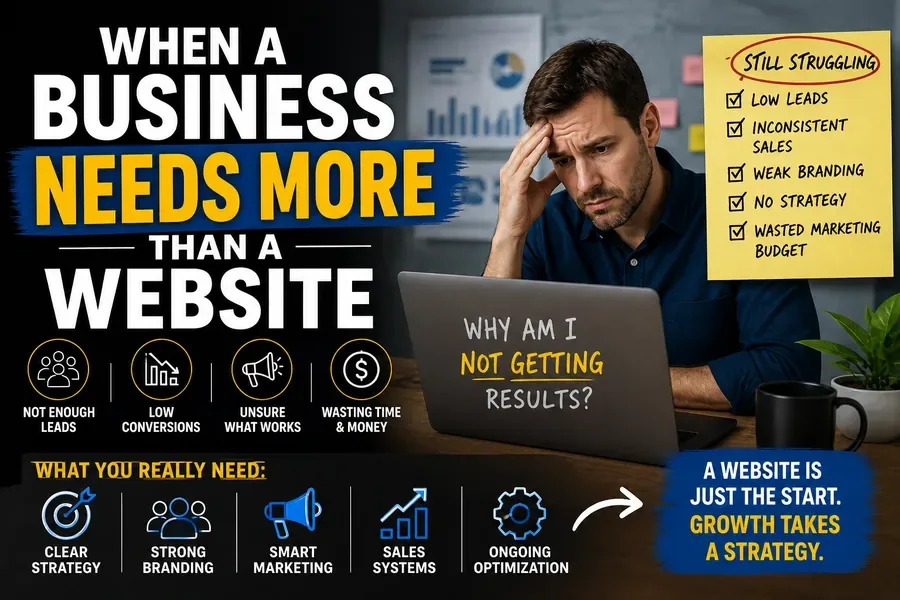
Signs You Need More Than a Website
- Your Google Business Profile gets more calls than your website — but no one is actively managing it
- You're generating leads but not getting reviews, so your reputation lags behind your actual quality
- You're spending on ads but have no system to follow up with leads who didn't book immediately
- Your competitors appear in the local map pack and you don't, even though you've been in business longer
- You've had a good website for a year and your organic traffic hasn't meaningfully grown
- You have no idea where your best customers came from or what made them convert
"A website without a discovery strategy is a billboard in a field with no road to it."
The Google Business Profile Gap
For local service businesses, a well-optimized Google Business Profile often delivers more leads than the website itself — particularly through the local map pack that appears for service-area searches. Yet GBP management is something most businesses either ignore entirely or treat as a one-time setup task.
Active GBP management means consistent posts, responding to every review, accurate hours and service descriptions, updated photos, and regular attention to Q&A. It's not complicated. It is consistent. And it moves rankings.
The Review Velocity Problem
Reviews aren't just a trust signal for prospective customers. They're a ranking factor in local search. A business with 12 reviews at 4.7 stars that hasn't received a new review in 8 months is losing ground every week to a competitor with 40 reviews at 4.5 stars that's getting 3–4 new reviews monthly.
Review velocity matters. Getting a steady flow of new reviews requires a system — not just hoping satisfied customers remember to post. That system includes a frictionless review link, a post-service follow-up sequence, and someone accountable for tracking it.
When Content Strategy Becomes the Missing Piece
Some businesses are in competitive markets where the website and GBP are strong but organic rankings haven't moved because the content strategy is missing. Competitors are publishing targeted service-area content, FAQ pages, and blog posts that capture long-tail search traffic. The sites that do this consistently build domain authority that compounds over months and years — and eventually generates traffic without ongoing ad spend.
What an Integrated Digital Strategy Actually Looks Like
For the local service businesses SDL works with, a complete strategy typically includes:
- A high-performance, conversion-optimized website
- An actively managed Google Business Profile with consistent posting and review response
- A review generation system embedded in the post-service workflow
- Monthly local SEO work — citations, content, and link building specific to the service area
- A basic lead nurture sequence that follows up with contacts who didn't book immediately
- Monthly reporting that connects activity to actual leads and revenue
Not every business needs all six immediately. But every business benefits from understanding which layer is the weakest link in their current situation.
The goal isn't complexity. It's clarity. When all three layers of your digital presence are working, you can see your business clearly — where leads come from, what's converting, and where the next opportunity is. That clarity is what a website alone can't give you.