Overview
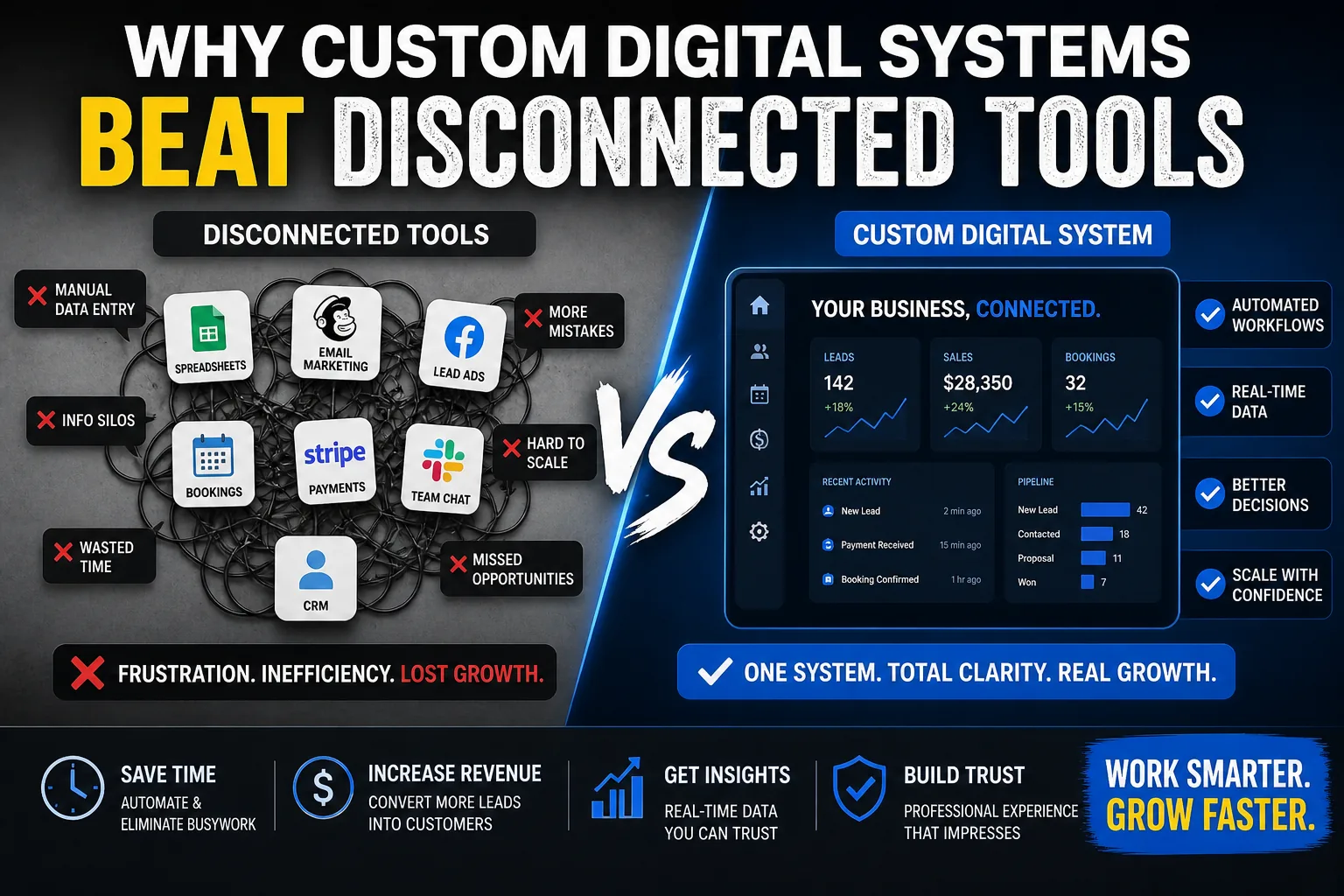
The signs are recognizable: you're re-entering customer data between systems. Your team is spending hours on manual exports and reconciliation. You can't see a complete picture of a customer's history or lead status without opening four different platforms. Important tasks fall through the cracks between tools that don't talk to each other.
This is the "disconnected tools" problem, and it's more expensive than most businesses realize — not just in software subscription costs, but in time, errors, and missed opportunities.
How Businesses End Up With Disconnected Stacks
It always starts with a reasonable decision. You needed to take online payments, so you added Stripe. You needed to track customers, so you added a CRM. You needed to send email campaigns, so you added Mailchimp. You needed to manage reviews, so you added another tool.
Each decision was logical in isolation. The problem is that these tools were never designed to work together. They share data imperfectly through integrations that break on updates, require automation platforms that need constant maintenance, or simply don't share data at all — leaving your team to do the bridging manually.
"A stack of twelve disconnected tools isn't a digital infrastructure. It's twelve monthly subscription fees and a full-time reconciliation job."
What a Custom Digital System Actually Does
A custom digital system isn't necessarily custom-coded from scratch — though sometimes that's the right answer. It's a deliberately architected stack where the key systems are integrated at a data level, not just visually. The customer record is one record. The lead history is visible in one place. Automations run reliably because they're built into the system, not bolted on with third-party connectors.
For a local service business, a well-integrated digital system might mean:
- Your CRM receives leads directly from your website form with no manual entry
- Your job management software syncs with your CRM so customer history is complete
- Your review solicitation email goes out automatically 24 hours after a job is marked complete
- Your monthly reporting pulls from a single source of truth rather than three different dashboards
- Your team has one login that shows them everything relevant to their role
The Hidden Cost of Tool Sprawl
The cost of disconnected tools is rarely calculated honestly because it's distributed across many people's time in small increments. Consider:
- 15 minutes per day per team member spent re-entering data between systems: at a modest $25/hour labor cost, that's $1,625/year per employee
- One missed follow-up per week because a lead wasn't transferred correctly: at a 20% close rate and $3,000 average job value, that's $31,200/year in lost revenue
- Three hours per month reconciling reports that should automatically match: $900/year in management time, plus the decision-making cost of operating on stale data
The SDL Approach: Systems Architecture Before Tool Selection
When SDL works with a business on digital infrastructure, we start by mapping the actual workflows — what data needs to go where, who needs to see what, and what should happen automatically versus manually. This architecture-first thinking is the foundation behind SDL's Sentinel Intelligence System (SIS) — a framework for connecting websites, CRMs, dashboards, and operational tools into one controlled layer. From that map, we select or build the tools that serve the workflow, rather than retrofitting workflows to accommodate whatever tools were already purchased.
This is the opposite of how most businesses build their stack. They buy tools first and figure out the workflow later. The result is a stack shaped by vendor sales processes rather than operational needs.
When to Rebuild vs. When to Integrate
Not every business needs to start over. Sometimes the right answer is a targeted integration layer that bridges existing tools — a well-configured CRM connection, an API integration between the website and job management software, or a custom reporting dashboard that pulls from multiple sources.
The decision depends on how far gone the current stack is. If the tools are fundamentally sound but poorly connected, integration can fix it. If the stack has grown into a fragile, expensive tangle where no one fully understands what talks to what, a phased rebuild is often the cheaper long-term path.
What the Other Side Looks Like
The businesses SDL has helped consolidate and connect their digital infrastructure describe the same outcome: they can see their business clearly for the first time. They know where leads come from. They know which jobs were most profitable. They know which marketing channels are actually working. They have time back.
That clarity — the ability to make confident decisions based on accurate, real-time information — is the actual return on investment from a well-built digital system. It's not a feature of any single tool. It's what happens when the tools work together.
The businesses that keep adding disconnected tools aren't growing their capabilities — they're growing their operational drag. At some point, the cost of the status quo exceeds the cost of doing it right. Most businesses that come to SDL for systems architecture arrive a year or two past that inflection point.