
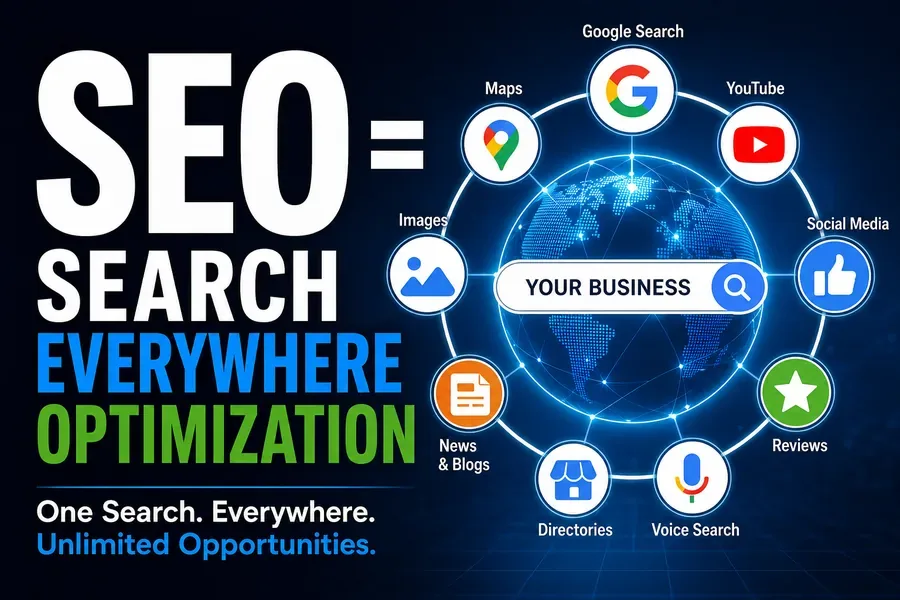
The Old Model: Just Rank on Google
For most of the last fifteen years, "getting found online" meant one thing: ranking on the first page of Google. Build a website, add keywords, earn some backlinks, and wait. If you showed up near the top of a Google results page, customers would find you. If you didn't, they wouldn't.
That model produced an entire industry — SEO — built almost entirely around one platform's algorithm. Agencies, consultants, and tools proliferated. Businesses spent significant money chasing Google's ranking signals. And for a long time, it worked.
The problem is that the model is now incomplete. It describes how customers found businesses five years ago, not how they find them today.
What Changed: Search Is No Longer One Place
The shift has been gradual enough that many businesses haven't noticed it. But the data is consistent with what we observe across the businesses we work with: a growing share of customer discovery no longer starts with a Google search bar.
It starts with a question asked to an AI assistant. A scroll through a social platform that surfaces a local recommendation. A search inside a map application. A voice query asked while driving. A prompt typed into a marketplace or platform with its own internal search layer.
None of these are Google. All of them are search.
The customer intent is identical — "I need someone who does X near me" — but the platform delivering the answer is no longer the same one businesses have spent years optimizing for.
The New Reality: Search Happens Everywhere
Consider how a homeowner in 2026 might look for a plumber:
They ask ChatGPT or Perplexity which plumbers in their area have strong reputations. They open Google Maps and look at who appears in the local map pack with recent reviews. They check Nextdoor to see if neighbors have recommended anyone. They scroll Instagram to see if any local plumbers have recent project photos. They ask their voice assistant while their hands are under a sink.
Each of those touchpoints is a search. Each one can surface a different business — or the same business repeatedly, which is exactly what you want. But you can only show up consistently across all of them if your digital presence is built for more than one platform.
"The businesses that win local discovery in 2026 aren't just ranking on Google. They're showing up in every channel where their customers look — and those channels are multiplying."
Why Traditional SEO Is No Longer Enough
Traditional SEO optimizes for one signal set: Google's algorithm. It focuses on keywords, backlinks, technical page health, and content volume. These things still matter. Google is still the highest-volume search platform. But traditional SEO leaves significant discovery on the table.
Here's what it misses:
- AI search tools (ChatGPT, Perplexity, Claude, Gemini) don't rank pages the way Google does. They synthesize information from multiple sources, prioritize businesses with consistent and credible information across the web, and surface results based on reputation signals that aren't fully captured in traditional SEO metrics.
- Google Maps operates on its own ranking logic, heavily influenced by Google Business Profile quality, review velocity, proximity, and category accuracy — factors that are separate from your website's SEO.
- Social platforms like Instagram, TikTok, and YouTube have their own internal search engines used by millions of people every day. A business with no social presence is invisible in those searches regardless of its Google rankings.
- Marketplaces and directories — Yelp, Angi, Houzz, Thumbtack, Bark — have significant organic reach and their own user bases that search within the platform.
- Voice search queries have different phrasing patterns than typed queries and often favor businesses with complete, structured data that assistants can confidently surface.
What Search Everywhere Optimization Actually Means
Search Everywhere Optimization is the practice of building a business's digital presence to be discoverable across the full range of platforms and channels where customer intent actually exists — not just Google.
It doesn't mean abandoning SEO. It means recognizing that SEO is one component of a broader discoverability strategy.
The core shift is in how you think about your digital presence. Instead of asking "how do I rank for this keyword?" the question becomes "how do I show up consistently and credibly wherever someone is looking for what I offer?"
That reframing changes which investments you prioritize and how you measure success.
The Core Components of Modern Visibility
Building for Search Everywhere Optimization requires attention across several distinct layers:
- Structured data and consistent business information: Your name, address, phone number, hours, and category data need to be accurate and consistent across every platform that indexes it — Google, Apple Maps, Bing, Yelp, Bing Places, Facebook, and dozens of directories. Inconsistency here creates confusion for both users and the algorithms that surface your business.
- Google Business Profile as a primary asset: GBP is not a one-time setup. It's an active content channel. Businesses that post regularly, respond to reviews, update photos, and maintain accurate service descriptions rank higher in Maps and appear more credibly in AI-generated local recommendations.
- Review volume and recency: AI tools and voice assistants heavily weight review signals when recommending local businesses. A business with 150 recent reviews is far more likely to be surfaced by an AI assistant than a business with 12 reviews from three years ago — regardless of their relative Google rankings.
- Content that answers questions, not just targets keywords: AI search tools are built to answer questions. Businesses with content that clearly explains what they do, who they serve, where they operate, and what makes them credible are more likely to be cited by AI tools than businesses whose websites are optimized for keyword density alone.
- Social presence as a discovery channel: Even a modest, consistent social presence — a few real project photos per month, a brief business update, a review highlight — creates indexed content on platforms with their own search layers. This isn't about follower counts. It's about being findable when someone searches for your service category on that platform.
Where Most Businesses Get This Wrong
The most common mistake we see is treating discoverability as a website problem. Businesses invest in SEO, launch a new site, and assume they've addressed their visibility issues. The website matters. But it's one channel among many.
The second most common mistake is treating each platform as a separate, unrelated task. GBP gets set up and forgotten. The Yelp profile is outdated. The Facebook page has a 2021 cover photo. Reviews haven't been solicited in months. Each of these feels like a minor thing in isolation. Together, they create a fragmented presence that no single platform can compensate for.
The businesses we work with that have the strongest local discoverability share one characteristic: they treat their digital presence as a system, not a collection of individual accounts. Everything that represents the business online is maintained with the same intention as the website.
What This Means for Local Service Businesses
For a plumber, HVAC contractor, roofer, or any other local service provider, the practical implication of Search Everywhere Optimization is straightforward.
You need your business information to be accurate everywhere it appears. You need a steady stream of new reviews on Google, and ideally on one or two other platforms where your customers look. You need your Google Business Profile to be actively maintained, not just claimed. You need some indexed content — whether on your website, your GBP, or social channels — that answers the questions your customers actually ask.
None of this is technically complex. None of it requires a large agency or a significant ad budget. It requires consistency and the understanding that discoverability in 2026 is a multi-channel problem with a multi-channel answer.
The businesses that treat it as such will increasingly outperform the ones still chasing a single keyword ranking on a single platform.
The Bottom Line
Google search will remain important. A well-optimized website will remain foundational. But the era when those two things were sufficient to build reliable inbound discovery is ending.
Customers are distributed across more discovery channels than ever before, and they expect to find credible, consistent information about your business wherever they look. Search Everywhere Optimization is the discipline of meeting them there — not just on the one platform you've been optimizing for since 2015.
The businesses that adapt to this reality early will build compounding advantages. The ones that wait will find themselves increasingly invisible in a discovery landscape that has moved on without them.