
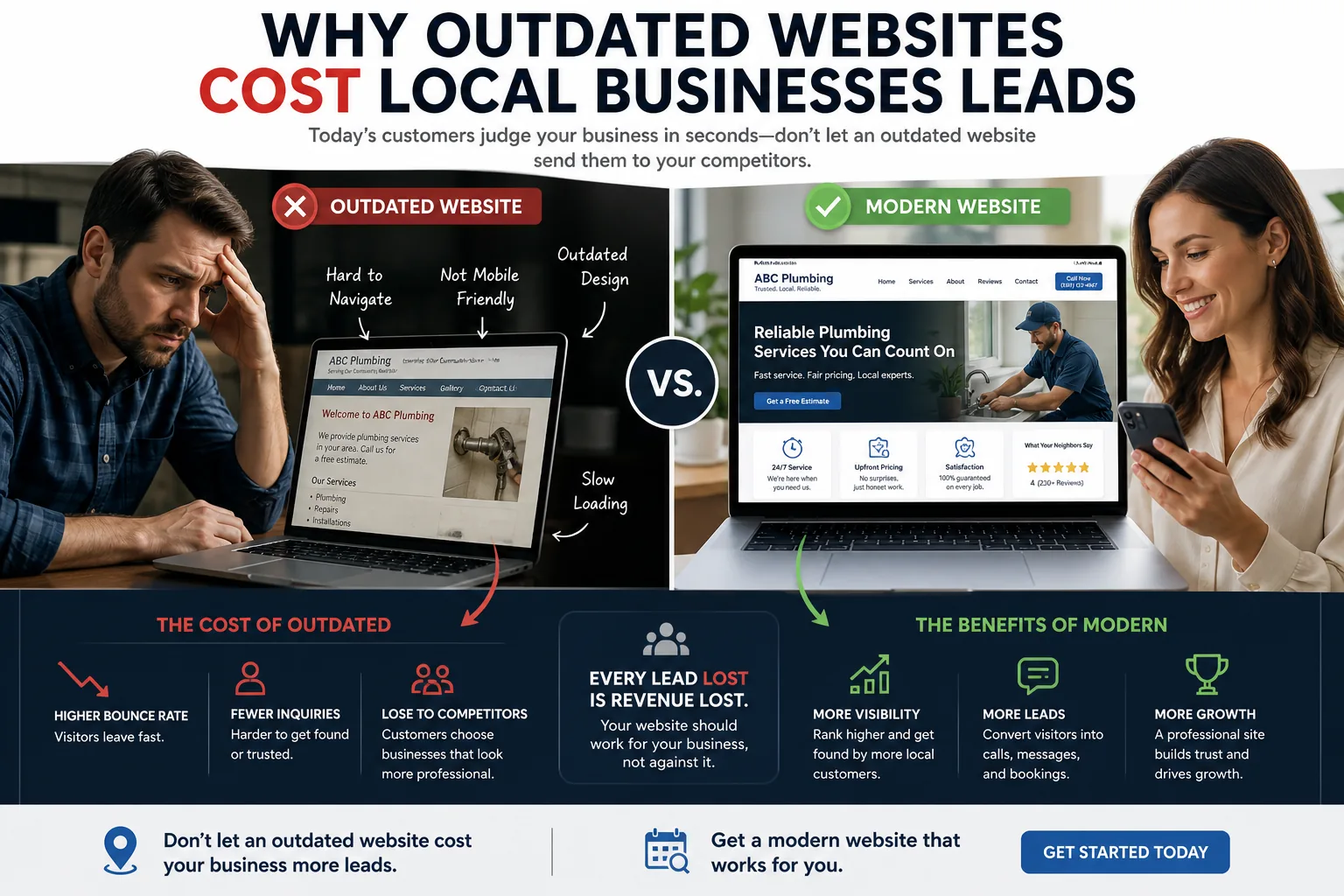
Overview
Here's a scenario that plays out dozens of times a day for local service businesses: a homeowner in your area Googles the service you provide. Your business shows up. They click your link. And then — within three seconds — they hit the back button and call your competitor instead.
You never knew they were there. You never got a chance to pitch your experience, your reviews, or your fair pricing. Your outdated website made that decision for them.
This isn't a hypothetical. It's happening to businesses right now — HVAC companies, roofing contractors, plumbers, auto shops, law offices, and every other local service provider operating on a website that hasn't been meaningfully updated in years. The digital landscape has changed radically. Most websites built before 2020 simply weren't designed for the world people are browsing in today.
The Invisible Leak in Your Pipeline
Most business owners track obvious metrics: phone calls, emails, booked jobs. But almost no one tracks the leads that never converted — the visitors who saw their site, bounced, and moved on. This invisible leak is the most expensive problem most local businesses have, precisely because it's so easy to ignore.
When your website fails a visitor, it doesn't send you a notification. It doesn't log the lost revenue. It just silently lets that potential customer slip away to a competitor whose site loaded faster, looked more professional, or simply had a phone number displayed where someone could actually find it.
The insidious part is that the more you spend on marketing without fixing the website first, the more you amplify the problem. Pay-per-click ads sending traffic to a slow, unoptimized site aren't driving leads — they're funding bounces.
"An outdated website doesn't just look bad — it actively works against every dollar you spend on ads, referrals, and reputation."
Five Ways an Old Website Is Costing You Right Now
- It's not mobile-first. Over 60% of local service searches happen on a smartphone. If your site isn't built for mobile, you're creating friction at the exact moment a customer is ready to act.
- It loads too slowly. A one-second delay reduces conversions by up to 20%. A site that takes five or six seconds on mobile isn't just annoying — it's a conversion killer.
- There's no clear call to action. If your phone number isn't prominent and your booking form isn't accessible, you're making people work for the privilege of giving you their money.
- Google can't find it. Outdated sites lack modern technical SEO — missing schema markup, poor page structure, no local signals. If Google doesn't understand what you do and where you serve, rankings suffer.
- It signals distrust. A dated design, broken links, outdated copyright dates, or generic stock photos all send the same message: this business doesn't pay attention to details.
The Real Cost: What One Lost Lead Is Actually Worth
Say you're a roofing contractor with an average job value of $9,500. Your website gets 300 visits per month. With a broken, outdated site converting at 1%, that's 3 leads a month. A well-designed, optimized site for the same business might convert at 4% — producing 12 leads. The difference is 9 leads. At a 30% close rate, that's nearly three additional jobs per month — over $27,000 in monthly revenue quietly disappearing.
Signs Your Site Is Costing You Leads Right Now
- Your site takes more than 3 seconds to load on mobile
- Your phone number isn't clickable or prominent on mobile
- You don't appear in the Google map pack for your core service keywords
- The design doesn't reflect the quality of work you actually do
- You're running ads but your cost-per-lead feels too high
- You're embarrassed to send a prospect to your own website
"When business owners hesitate to share their own URL, they already know the answer."
What a High-Performing Local Website Actually Looks Like
A site that converts doesn't need to be flashy. It needs to be fast, clear, and credible. That means a mobile-first design with a click-to-call button above the fold. Service pages that clearly define what you do and where you do it. Real photography of your work. Reviews visible without scrolling. And a contact form that actually works — confirmed with a thank-you page that a conversion event can be tracked against.
Every element should serve one of three purposes: building trust, making contact easy, or helping Google understand what you offer and where. Everything else is decoration.
The businesses winning local search in your market almost certainly have one thing in common: a website built with intention, optimized for modern performance standards, and treated as a living sales tool — not a digital brochure published five years ago and forgotten.
Your website is your hardest-working, lowest-complaining team member. It's on the clock every hour of every day. The question is whether it's closing deals or losing them.